A Material That Starts in the Ground, Not a Factory
Every piece of Sukabumi Green Stone we ship begins the same way: as a raw block of andesite, still part of the volcanic rock formations of the Sukabumi Regency in West Java. Unlike manufactured or reconstituted stone products, nothing about this material is cast, dyed or engineered in a mould — the entire process is about carefully extracting, cutting and finishing a naturally occurring rock while preserving the mineral characteristics that make it valuable in the first place.
This article walks through that process end to end: quarrying, block selection, cutting, finishing, and the quality control checks every batch goes through before it’s packed for export.
Step 1: Quarry Extraction
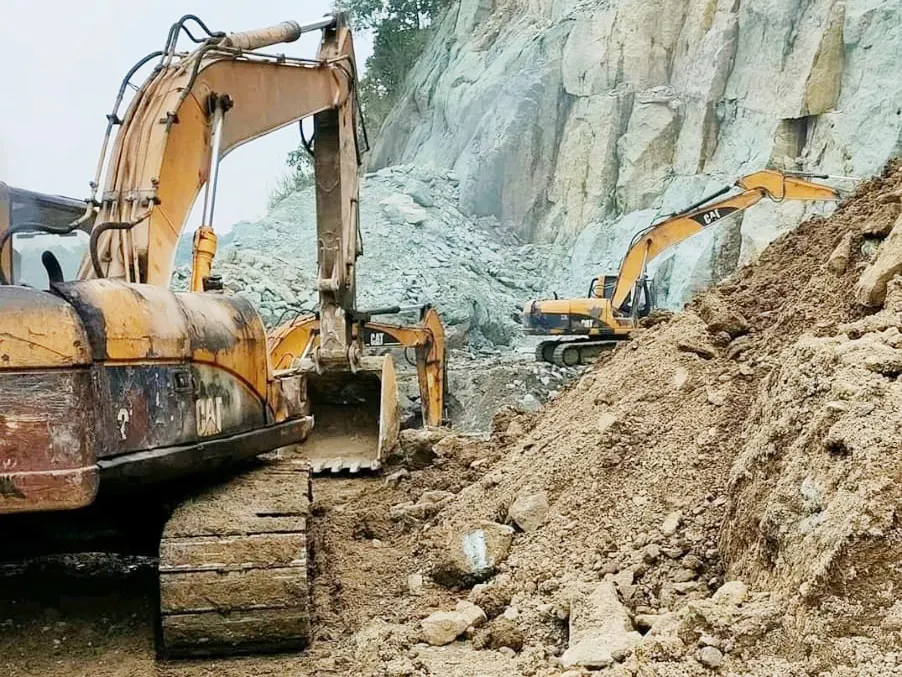
Extraction happens at open rock faces where the andesite deposit is exposed. Heavy equipment — typically hydraulic excavators fitted for rock breaking — is used to separate large sections of stone from the quarry face, working along the natural fracture lines of the rock where possible to reduce waste and avoid unnecessary stress fracturing within usable blocks.
Not every extracted section becomes finished product. Quarry teams visually inspect each block for the mineral consistency and colour depth that define genuine Sukabumi Green Stone — sections with excessive fracturing, inconsistent colour banding, or contamination from surrounding rock types are set aside. This selection step matters more than it might seem: it’s the first and most important quality checkpoint in the entire supply chain, because no amount of downstream cutting or finishing can fix a block that started with the wrong mineral character.
Selected blocks are then transported from the quarry to our production facility for cutting.
Step 2: Primary Cutting
At the factory, raw blocks are cut down using diamond-bladed wet saws — water is continuously applied during cutting both to cool the blade and to suppress stone dust. This is the stage where a rough block becomes a set of manageable slabs or billets, cut to rough dimensions ahead of precision sizing.
Water-cooled cutting also has a quality benefit: it reduces the heat stress that can cause micro-fracturing in the stone, which matters for a product that will ultimately be installed in pool decks and other high-traffic outdoor applications where structural integrity is non-negotiable.
Step 3: Precision Sizing
Once rough-cut, slabs move to precision sizing, where they’re cut to the exact tile, paver or coping dimensions ordered — whether that’s a standard 20 x 20cm tile or a custom-cut coping profile for a curved pool edge. This is also where format-specific cuts happen: bullnose edge profiles for pool coping, mesh-mounted mosaic chips for waterline tile, or thin veneer cuts for cladding panels.
Because Sukabumi Green Stone is a natural material, minor thickness and colour variation between individual pieces is normal and expected — this is part of what distinguishes genuine natural stone from a manufactured look-alike, and it’s something we flag to first-time buyers so it isn’t mistaken for an inconsistency in quality.
Step 4: Surface Finishing
Finish is applied after sizing, and this is where a huge amount of the stone’s final character comes from. Depending on the order, pieces go through one of several finishing processes:
- Natural cleft — the stone is split along its natural grain rather than mechanically ground, producing a textured surface with the highest slip resistance of any of our finishes. This is the most requested finish for pool decks.
- Honed — mechanically ground to a smooth, matte surface for a more contemporary look.
- Tumbled — pieces are tumbled with abrasive media to soften edges and create a weathered, rustic texture.
- Bush-hammered — a mechanical hammering process that creates a deeply textured surface, used where maximum traction is required.
- Sandblasted — fine abrasive blasting for an even, matte texture.
- Flamed — a high-heat torch is applied to the surface, causing the outer mineral layer to fracture into a rough, slip-resistant texture with a slightly lighter tone than the base stone.
Each finish changes not just the appearance but the functional performance of the stone — slip resistance in particular varies meaningfully by finish, which is why we recommend natural cleft or bush-hammered for pool decks and coping specifically, rather than a purely aesthetic choice.
Step 5: Quality Control
Before any batch is approved for packing, finished pieces are checked for dimensional accuracy (consistent sizing within tolerance), surface consistency (finish uniformity across the batch), and structural soundness (no hairline fractures introduced during cutting). Pieces that don’t meet these standards are set aside rather than shipped — a practice that matters more for export orders than domestic ones, since a buyer 15,000km away has no opportunity to inspect and reject individual pieces before a container is loaded.
For buyers who require it, we support independent third-party pre-shipment inspection (such as SGS or Sucofindo) as an additional verification layer on top of our internal QC process.
Step 6: Packing for Export
Finished, QC-approved pieces are palletized — typically shrink-wrapped or crated with corner protection — and prepared for container loading. Packing is optimized to maximize safe square-metre yield per container while protecting edges and corners from chipping in transit, which is one of the more common (and avoidable) causes of damage claims in natural stone export when packing is done carelessly.
From there, palletized stone moves to the port for loading under the Incoterm agreed with the buyer — see our export process guide for the full breakdown of FOB vs. CIF pricing, required documents, and typical container yield by product format.
Why This Process Matters for Buyers
If you’re evaluating a Sukabumi Green Stone supplier, the honest answer to “why does this matter to me” is risk reduction. A buyer who understands the actual production process — not just marketing photos — is better equipped to ask the right due-diligence questions: Is the block selection genuinely happening at the quarry, or is a trading company blending stone from multiple sources under one label? Is cutting water-cooled, or is heat stress being introduced that won’t show up until the stone is installed? Is there an independent QC step, or is “quality checked” just a line on a website?
We publish this process openly — including the factory photography referenced throughout this article — because for an overseas buyer who will likely never visit the quarry before placing a deposit, operational transparency is the most meaningful trust signal we can offer.